

Mastering the Art of Writing a Research Paper: Key Insights 📖
As Albert Einstein once said:
“The important thing is not to stop questioning. Curiosity has its own reason for existing.”
For many students, research and writing assignments can feel overwhelming, often viewed as tedious and burdensome tasks. For some, these assignments are seen as just another academic hurdle, similar to an exam, something to get through rather than something to embrace.
However, academic experts and thinkers disagree with this mindset. A research paper is much more than a mere requirement, it’s an opportunity for inquiry, exploration, and deep understanding.

What is a Research Paper?
A research paper is a comprehensive written work that begins with posing a question or hypothesis. From there, the writer delves into rigorous analysis and evaluation of the subject matter, providing evidence, and contributing new insights to the topic at hand. It’s a process that allows for intellectual growth and critical thinking—much more than just a formal essay.
This definition introduces a layered challenge. It suggests that students aren’t just answering pre-existing questions; they must first formulate the question themselves and then find the answer. This approach assumes that the writer has a genuine curiosity and motivation to explore their chosen topic. It also requires that the student possesses the necessary discipline, knowledge, and cognitive ability to handle the task at hand.
Instead of viewing research assignments as burdens, students should recognize them as opportunities for growth. Like any tool, the key is in learning how to use it effectively to unlock its full potential.
This guide will walk you through the research process, helping you understand the purpose and function of each step along the way.
As you progress through this guide, you’ll uncover:
- a methodical approach to analyzing and refining your thoughts
- understanding academic writing and its time commitment
- a clear outline of the steps to follow as you research and write
- essential tools and resources that will support your success
- insights from students on the writing process
1. An Academic Research? 🤔
As mentioned in the introduction, a research project is essentially an exercise in essay writing. However, it differs significantly from the standard essays you may have written in middle school.
First, unlike in previous assignments, your teacher won’t provide you with a prompt. You’ll need to determine your own topic and decide what to research.
Second, the ideas you present in your research paper should involve a critical analysis of existing knowledge. This is a departure from past essays where you may have primarily focused on expressing your own thoughts. In this sense, scholarly writing is more similar to writing a book report, where you engage with existing research and perspectives, rather than just presenting personal opinions.





In many ways, writing a research paper is not so different from composing a thesis. Both are rigorous academic tasks, and the processes to create them share many similarities. However, each has its own unique elements that set it apart from the other.
In many educational systems worldwide, ‘thesis‘ and ‘academic paper‘ are often used interchangeably, but this can lead to some confusion, especially regarding terms like ‘research question’ and ‘methodology.’ Although the overall writing process may seem similar, there are key differences in how these documents are treated.
In the United States, however, there’s a clear distinction. University undergraduates are typically required to write and defend a thesis as a significant academic exercise. Additionally, students may be asked to submit term papers, which are more common assignments that professors assign throughout the semester.
Students at levels below university may also be assigned term papers. In this guide, we will focus on this type of assignment and explore how to approach and complete it effectively.
A term paper is typically due at the end of the school term or semester during which it was assigned, giving students anywhere from three to five months to complete it. In contrast, a research project can span a much longer period—anywhere from one to three years or more—depending on your academic level and the depth of the research required.
Undergraduate students generally have more time to complete their projects, but the expectations are also higher. At this level, the research requires more detailed and thorough presentations. For example, students are expected to explain and justify their research methodology in greater depth. They will also need to apply a variety of research and analytical methods, tailored to their specific subject and the type of data they are working with.
The kind of data you choose for your research will depend on your academic field. For example, disciplines like language studies, the arts, and marketing often require qualitative analysis, while scientific, mathematical, and business-related subjects tend to rely on quantitative data.
However, a combination of both mixed data can be highly beneficial across various fields. Rather than sticking to one data type based solely on your subject, consider integrating both qualitative and quantitative approaches to gain a richer and more complete understanding.
Although different research methods and data types may require varied approaches, university students generally have more flexibility with time. Starting your research early is crucial for staying on track. The sooner you begin, the better your chances of completing your project on time, while also sparing yourself from the constant reminders of your advisers.
Source: Academic Support · Rose on writing the dissertation
Looking at both timelines, and as Rose points out, collecting statistics and background details is often the fastest step in the research process, particularly now that search engines streamline the task.
After assembling reliable information that allows you to form some preliminary insights, the next move is to craft your central research question. This question should be precise and narrowly focused, since tackling an overly general idea can result in shallow or unfinished findings.
2. From Idea to Inquiry: Building Your Research Question 💡
Many individuals jump into a project without fully considering the obstacles that may surface later. They might expect challenges in general, but not recognize exactly what form those difficulties will take.
Perhaps you’ve also begun with enthusiasm, only to reach a moment of wondering, “What did I get myself into?”
That’s why it’s essential to refine your area of interest into one clear, guiding question. By stepping back and analyzing the underlying issues, you can identify the specific problem you most want to investigate.
Root Cause Analysis (RCA) involves repeatedly questioning what, why, and how until you identify a problem that lacks an immediate solution. This method reveals the underlying motivation behind your interest in the topic. Once that purpose is clear, you can begin gathering the information needed to explore it further.
Why Focus on This Topic?
You can’t hone in on a research question until you understand why you wish to pursue this subject or topic. You may have more than one reason but, if that’s the case, you must decide which reason is the most important. That will help inform your style, and your document’s content. These are the main reasons students choose their course of study.
No matter which column—first, second, or third—captures your primary motivation for selecting this topic, that underlying reason becomes the foundation of your research question. Consider what you most want to discover within this field, aligning your inquiry as closely as possible with why you chose it in the first place.
How to Decide on a Research Topic
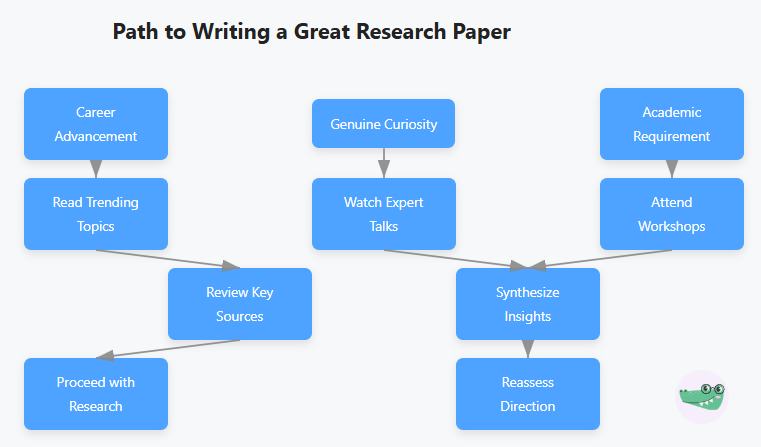
Source: Own conception “Review the potential purposes behind studying a field.”
Managing Time
Suppose a student realizes that the available resources for their selected topic are insufficient to answer their research question. In that case, they will need to identify a new angle or subject to investigate. This situation occurs more frequently than many expect.
Given the abundance of potential topics, students often struggle to find one with sufficient resources to support their arguments. Completing the RCA process as early as possible gives them a significant advantage in locating the necessary documentation.
3. Exploring Previous Research
A literature review involves examining and assessing the body of existing work connected to your topic.
This process requires extensive reading, as drawing information from multiple sources ensures your work remains well-rounded. While reviewing the literature, make detailed notes on the points and arguments presented by different authors.
If you encounter several papers addressing the same idea by a single author, take time to investigate that author’s background as well. Understanding their perspective provides valuable context, even if you don’t explicitly include that information in your final paper.
Different Types of Sources
At first glance, you might assume these types refer to formats like print, video, or online sources. That’s a reasonable guess, but in academic writing, the standard distinction is between primary and secondary sources.
Primary sources consist of first-hand accounts such as diaries, memoirs, and personal letters, providing direct evidence relevant to your topic. In contrast, secondary sources are works that analyze, interpret, or summarize information from primary materials.
Distinguishing between primary and secondary sources isn’t always straightforward. For example, a student studying labor practices might treat trade journals as secondary sources. Yet if their focus is the history of labor unions, those same journals could serve as primary sources.
How to Identify Quality Sources
We’re lucky to live in an era where the vast expanse of human knowledge is just a click, or even a voice command, away. You don’t need to type full questions; a few keywords will generate thousands of results in seconds.
Yet, navigating this overwhelming amount of information can be intimidating, even for the most determined researcher. To avoid getting lost in endless facts, figures, and documents, using search qualifiers can help narrow your results and make your research more manageable.
Even with these search operators, you’ll still need to review the results and assess their relevance. Luckily, there’s a single simple test to help you decide.
It’s important to ensure your information is as current as possible. While older materials can provide valuable historical context, your analysis should primarily rely on the most up-to-date data.
The intended purpose of a source also affects its credibility. For example, websites ending in .edu, .org, or .net typically provide content suitable for academic research, whereas .biz, .com, or .pro domains tend to offer general or industry-focused information.
Using reliable sources is the key to obtaining trustworthy results. Your school or local library is a great place to start, and your teacher may provide recommended books and websites. How many of these resources have you already explored?
Resources to Support Your Research
Exploring the literature on your topic, along with reviewing authors’ backgrounds, requires careful organization. It’s essential to get acquainted with effective tools and apps before starting your research project. While a classic spreadsheet can do the job, modern applications can be just as effective.
Approach to Research
When planning your research, you’ll select the tools and methods that most effectively help you achieve your objectives. Reviewers won’t be able to infer your choices or reasoning on their own, so you need to clearly explain them.
Think of it like showing your work in a math problem or justifying an essay answer. Instructors want to understand the steps you took to reach your conclusion, even if the final result is correct.
This section is about possibilities. You want to lay out the goals you hoped to achieve, and your anticipated results. You must also explain how you expected your process to achieve them. In this discussion, you must declare whether you applied qualitative, quantitative, or mixed methodology.
Your methodology chapter must maintain a past-tense tone, even if you’re still drafting on your project. It should read as though you’re reflecting on past work, and explaining your past actions.
4. Crafting an Academic Essay
Even the most celebrated researchers encountered difficulties while writing their papers. You may find that you face similar personal and academic challenges during your own drafting process—and perhaps notice a recurring pattern.
One consistent piece of advice from these experts is that adhering to established guidelines greatly eases the writing process. Among these, following the recommended length for each section is often the simplest and most practical guideline to apply.
| ⚙️ Component | ❓ What to include | % How much of your paper |
|---|---|---|
| Introduction |
Your topic overview. Your research question, with an outline of your work’s scope and purpose. Information to grab the reader’s interest. |
10 – 12% |
| Literature Review |
Organize selections by theme. Summarize each source. Evaluate each entry’s strengths and relevance. |
15 – 20% |
| Methodology |
What your research aims to prove. Description of your research design. Methods and materials used. Explain methods and techniques to interpret your data. |
10 – 12% |
| Findings/Results |
Key findings, especially those related to your research question. Charts and graphs. |
15 – 20% |
| Discussion |
Interpreting results, importance and relevance to your topic. Point out limitations. |
15 – 20% |
| Conclusion | Summarizing your findings, and the whole paper. | 5 – 7% |
| Bibliography | Your primary and secondary sources | 5 – 7% |
The percentages show that certain sections require more time to complete than others. This means it’s wise to focus on those major components first, rather than on secondary parts like the introduction or bibliography. In fact, saving the introduction for last can be beneficial, as it allows you to select precise keywords that align closely with the arguments you develop in your paper.
What’s the best order for writing your paper?
Working from the introduction straight through to the conclusion can feel repetitive, since you’ll likely end up rewriting early sections. A smarter approach is to begin with your literature review or methodology chapter, and build your reference list as you go.
Your first step should be to draft an outline. You can use a standard structure—introduction, literature review, methodology, discussion, and so on—as your framework. It’s also helpful to create a timeline with specific deadlines for each stage, leaving space to jot down notes under every task.
These notes might include key points you want to cover, updates on your progress, or questions to raise with your teacher. Be ready for detours—sometimes a small piece of information can lead you down an unexpected path. Even if it doesn’t directly fit into your paper, the extra knowledge will broaden your understanding of the subject.
Unlike essays, research papers don’t need a smooth story-like flow from chapter to chapter. It can help to treat each section as its own mini-essay, supported by the surrounding material. Breaking it down this way makes the workload less overwhelming and allows you to adopt the right tone for each part.
For example, your methodology should read as though you’re reflecting on your process, while your discussion should carry energy and enthusiasm to show your personal engagement with the topic.
Trying to force one single tone across the entire paper makes the task harder. Instead, think of it as a set of interconnected pieces. This perspective not only makes writing more manageable but also helps you stick to your schedule with confidence.
Check out this YouTube video for deeper insights into how academic writing works.
5. Creating a Bibliography
As you worked through your literature review and gathered information, you should have been keeping track of your sources. If so, you’ve already completed the most time-consuming part of building a bibliography. The final step is simply organizing and listing them at the end of your paper.
Of course, that’s not always as straightforward as it sounds. Should you create a “Works Cited” page, a “References” list, or a full bibliography? Each serves to document the materials you relied on in your writing, but the distinctions between them can be confusing.
To make things more complex, your sources must be cited in a specific style. Globally, writers often rely on systems such as Chicago, Turabian, or MLA (Modern Language Association). When it comes to in-text citations, the APA (American Psychological Association) style is frequently the preferred choice.
Typically, either your instructor or the assignment guidelines will specify which citation style to use. In the United States, the most common requirements are MLA or APA, both of which also provide rules for citing online sources.
The bibliography is the key reason you should record every source you consult during your research. If you don’t end up using a source, you can simply leave it out. But if you do want to include it later, tracking it down again will be far more difficult if you didn’t note it the first time.
Some students don’t mind typing all their citations by hand, but this can be a slow and tedious process. Luckily, there are free citation tools like EasyBib that can generate references for you. All you need to do is enter the source details, and the tool will format the citation correctly.
These generators can produce citations in different styles and handle sources from almost any medium. Just imagine how much time you’ll save by letting them handle the formatting!
6. A Checklist Before Submitting Your Work
For many students, writing a research paper can feel tedious or even meaningless. Yet the real reward lies not in pleasing your professors but in the growth you gain from the process itself.
Imagine sitting at your desk, surrounded by drafts and notes, carefully reviewing your work. In that moment, it may not feel particularly transformative. But when you step back later, you’ll notice the progress you’ve made, not only as a writer, but as a thinker.
Composing a research paper requires more than assembling sources; it begins with an honest look at your own curiosity and willingness to engage deeply with a subject. That initial self-examination strengthens your commitment and fuels the persistence you’ll need to finish.
Ultimately, this exercise sharpens your intellect, tests your curiosity, and pushes you toward self-discovery. Even Socrates argued that self-examination was a lifelong pursuit, research and reflection are simply modern ways of continuing that tradition.
From a drafting perspective, self-examination helps cut through all the external distractions—the “noise” of peers, parents, grades, competition, and society’s insistence on achievement. When those pressures quiet down, what remains is clarity: your research question begins to reveal itself. Once you’ve identified the issue you want to explore, the process unfolds step by step:
- Create an outline to give your paper structure.
- Conduct a literature review, refining your question if necessary.
- Compile your bibliography as you read and engage with sources.
- Collect and organize your data, ensuring it is accurate and reliable.
- Analyze the evidence and document your methodology.
- Draft the most challenging sections first, while your focus is strongest.
- Frame your work with a purposeful introduction and a complete bibliography.
- Revise and proofread each section as you progress, and polish the entire paper once complete.
The timeline for this process varies by academic level: a middle or high school project may span a year, while undergraduate or advanced work might extend over several years. Regardless of deadlines, the true value of the assignment lies not in the grade but in the intellectual and personal growth it fosters. As Supriya reminds us, this work ultimately enriches you.
Source: Academic Support · Supriya on why research and writing is crucial for designers
It’s best to approach a research paper not as a mandatory rite of passage, but as an opportunity for genuine growth. With that mindset, you’re more likely to work with focus and enthusiasm, instead of falling into procrastination or settling for “good enough.”
Although writing is a deeply personal endeavor, you don’t have to face it in isolation. Teachers and advisers can provide guidance, while friends and family offer encouragement. Still, there are times when you may need more specialized support.
Platforms like Toprofs connect you with mentors across every discipline, including writing coaches who can sharpen your composition skills and boost your confidence. If you feel uncertain about your ability to express your ideas clearly, a few targeted sessions can make a significant difference.
Alternatively, you may find that your challenge lies not in writing, but in fully grasping the subject itself. In that case, working with a subject-specific tutor can help you uncover missing connections, clarify difficult concepts, and open up fresh perspectives. Often, just a few brainstorming sessions are enough to reignite your motivation and guide you toward new insights.
Bibliographic references
- Chegg. (n.d.). Works cited vs. bibliography vs. references. https://www.citethisforme.com/citation-generator/citation-basics/bibliography-vs-works-cited-vs-references
- Daniel Parker. (n.d.). How to research a topic: A step-by-step guide. EssayPro. https://essaypro.com/blog/how-to-research#Conclusion
- GeeksforGeeks. (n.d.). Difference between thesis and research paper. https://www.geeksforgeeks.org/business-studies/difference-between-thesis-and-research-paper/
- Llebot, C. (n.d.). Data types & file formats. Oregon State University Library Guides. https://guides.library.oregonstate.edu/research-data-services/data-management-types-formats
- Purdue OWL. (n.d.). MLA works cited page: Basic format. Purdue University. https://owl.purdue.edu/owl/research_and_citation/mla_style/mla_formatting_and_style_guide/mla_works_cited_page_basic_format.html
- University of Chicago Library. (n.d.). Data formats and naming. https://guides.lib.uchicago.edu/datamanagement/organizing
- University of Texas at Arlington Library. (n.d.). Research data management: File format selection. https://libguides.uta.edu/datamanagement/format
- University of Western Australia. (n.d.). Planning a research project. https://www.uwa.edu.au/students/-/media/Project/UWA/UWA/Students/Docs/STUDYSmarter/HM1-Planning-a-research-project.pdf
🔗 Helpful Related Posts:
Superprof Apprentus



1 Comment
level experience
premium tutoring platform. Very well done!