

AI in Education: Effectiveness, Application, and Impact 📈
Artificial Intelligence (AI) is no longer futuristic: it is already in the classroom, in lesson planning, and in school administration. The key question for any educator or institution is not if AI should be used, but how to use it in a pedagogically meaningful, ethical, and effective way.
In this post, we will cover:
- 📜 What international organizations and regulations say about AI in education.
- 📊 The current state of AI in education (with fresh data).
- 🛠️ Where AI adds real value today.
- ⏱️ How to implement AI in your classroom or institution in 90 days.
- 📐 Metrics to evaluate results.

1) The State of AI in Education: Key Numbers That Matter
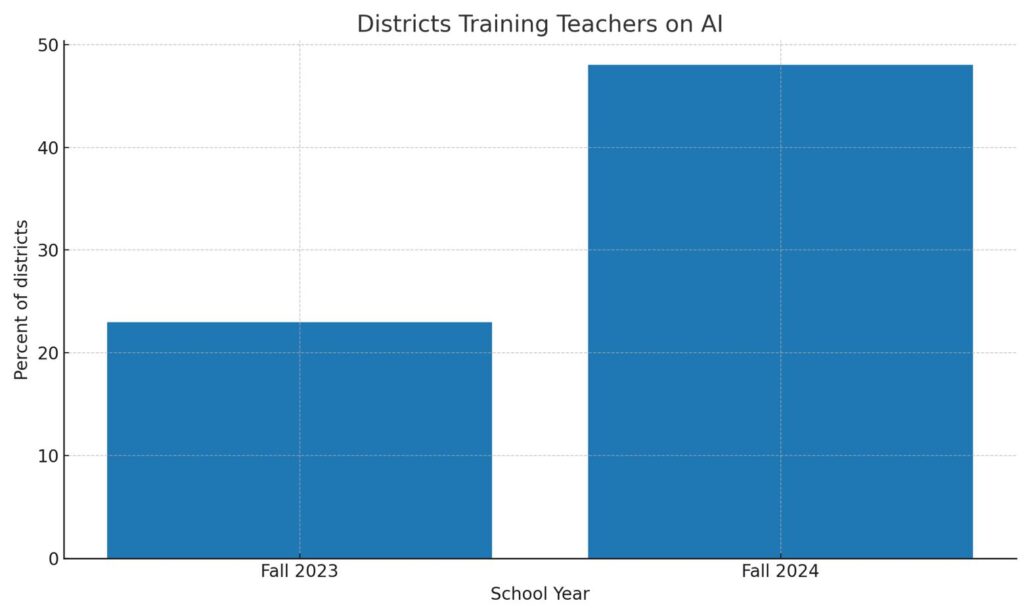
By Fall 2024, 48% of school districts in the U.S. reported training their teachers on AI — a sharp increase from 23% in Fall 2023 (+25 percentage points in a single year).
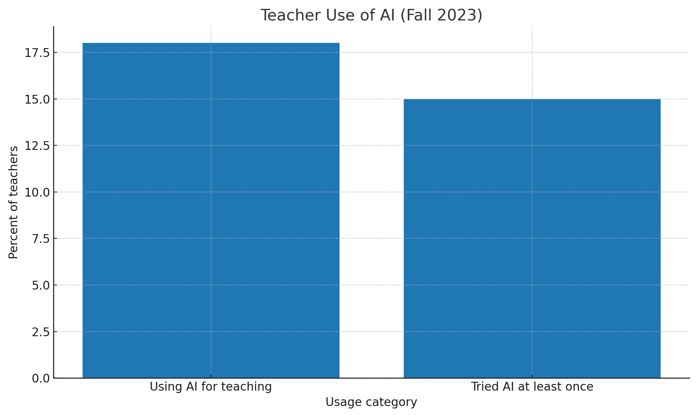
In Fall 2023, 18% of teachers said they were actively using AI in their teaching, while 15% had tried it at least once.
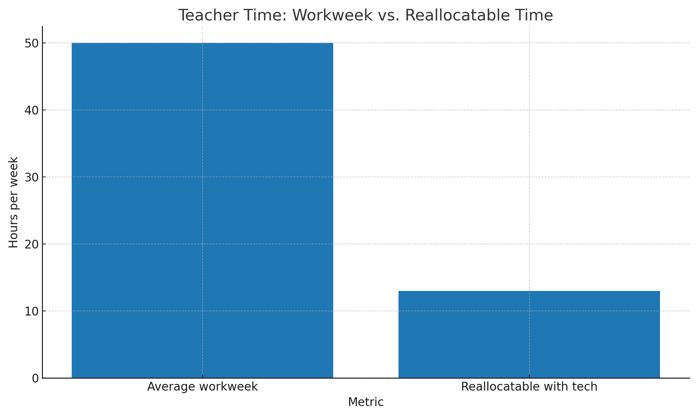
Teachers still work an average of 50 hours per week, yet existing technology could reallocate 20–40% of that time (≈ 13 hours per week) to higher-value tasks such as feedback, tutoring, and personalization.
The global education market is projected to exceed $7.3 trillion by 2025. EdTech remains a major driver of innovation, although funding is becoming more selective.
Organizations like UNESCO and the OECD have published guidelines for human-centered, responsible AI adoption in education.
Charts
📈 District training in AI (2023 vs 2024)
👩🏫 Teacher AI usage (Fall 2023)
⏳ Teacher time: total workload vs time reallocated by AI
2) Where AI Adds Value Today





👩🏫 Lesson Planning & Preparation
- Drafts of lesson plans, rubrics, and resource lists in minutes.
- Potential time savings: much of the 13 hours/week that can be reallocated comes from preparation and grading.
📝 Assessment & Feedback
- AI can generate automatic rubrics and instant feedback for objective tasks.
- This increases the frequency of student feedback without increasing teacher workload.
📈 Personalized Learning
- Adaptive platforms diagnose student levels, regroup learners, and suggest activities.
- Requires alignment with curriculum and teacher training to scale effectively.
🗂️ Administrative Tasks
- Summarizing meeting notes, drafting family communications, scheduling.
- Teachers save cognitive load for the human side of education: empathy, motivation, guidance
3) A Practical 90-Day Implementation Roadmap
Month 1: Awareness & Training
- Host short workshops on what AI can and cannot do.
- Provide ethical guidelines for responsible use.
- Survey teachers and students to assess readiness.
Month 2: Pilot Use Cases
- Select 2–3 AI tools (e.g., lesson-planning assistant, grading assistant).
- Run a small pilot in specific subjects (e.g., English essays, math practice).
- Collect feedback from teachers and students.
Month 3: Evaluation & Scaling
- Measure time saved, student satisfaction, and learning outcomes.
- Adjust policies for privacy, data protection, and inclusion.
- Decide on scaling successful pilots across subjects or grade levels.
4) How to Measure Results
🔐 Compliance: data privacy and adherence to local/European AI regulations.
⏱️ Time efficiency: weekly hours saved per teacher.
🎓 Student performance: improvement in assessment scores or mastery.
😀 Student engagement: surveys on motivation, classroom participation.
🧑🏫 Teacher satisfaction: perceived workload reduction and support.
5) Policy & Ethics: What We Must Not Forget
UNESCO (2021): AI must remain human-centered, respecting ethics, privacy, and fairness.
OECD (2023): emphasizes teacher training and transparent governance.
European Union (AI Act, 2024): categorizes education-related AI as “high-risk”, requiring strict safeguards.
Conclusion
AI in education is not a silver bullet — but when applied responsibly, it saves time, personalizes learning, and empowers teachers to focus on what they do best: nurturing critical thinking, creativity, and human connection.
The challenge for 2025 is clear: move from hype to measurable impact. 🚀
Bibliographic references
- RAND Corporation (2023, 2024). American Educator Panels – Surveys on AI Use in Schools.
- McKinsey Global Institute (2020). How artificial intelligence will impact teachers’ time.
- UNESCO (2021). Recommendation on the Ethics of Artificial Intelligence.
- OECD (2023). AI in Education: Policy and Practice.
- Elias Benamar Hilal (2025). Top 3 Best Tutoring Platforms Ranking. SSRN: https://papers.ssrn.com/sol3/papers.cfm?abstract_id=5366765
- EdTech Market Outlook (HolonIQ, 2023; World Bank, 2024).
🔗 Helpful Related Posts:
Superprof Apprentus



Leave your comment